
Home health marketing works best when it focuses on referral sources first: physicians, hospital case managers and skilled nursing facilities. Back that up with an accurate Care Compare listing, a strong Google Business Profile, reviews and a website that makes referring easy. Keep every gift and incentive inside Anti-Kickback rules.
- Most home health admissions start with a referral from a physician, hospital or facility, so relationships come first.
- Your Care Compare star ratings and patient survey results are public. Referral sources and families read them.
- Google Business Profile, reviews and a clear website still matter. Families check you before they agree.
- Talk to a healthcare attorney before giving anything of value to a referral source.
How patients reach a home health agency
Medicare home health starts with a certification. A physician or allowed practitioner has to confirm the patient qualifies and document a face-to-face encounter. So almost every admission passes through a clinician, a hospital discharge team or a skilled nursing facility.
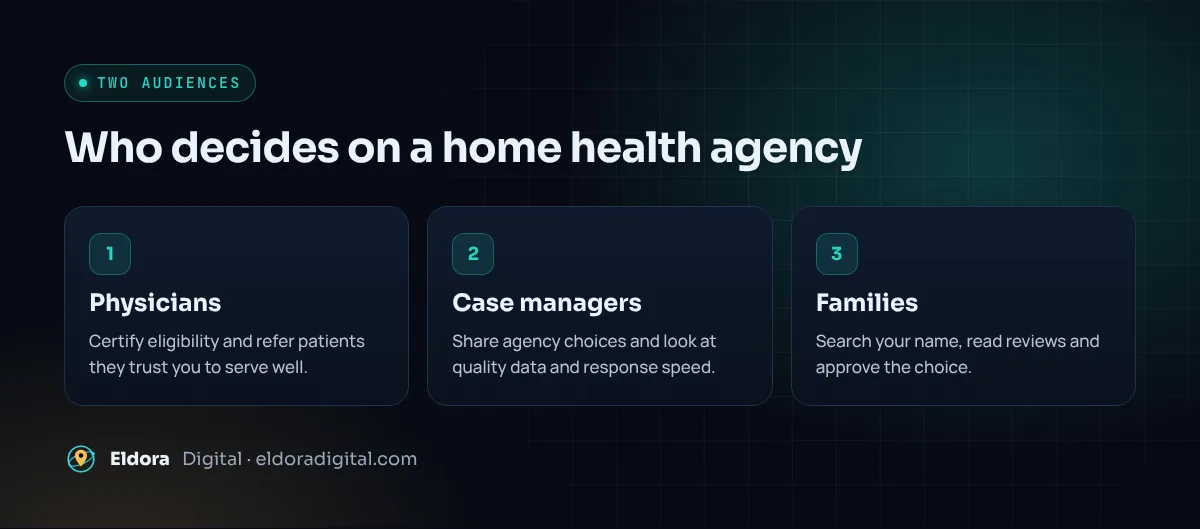
Patients still have a say. Hospitals must offer a choice of agencies, and discharge planning rules ask them to share quality information to help patients decide. That means two audiences matter: the professionals who refer and the families who approve.
If you also run private-pay services, keep the messaging separate. Our home care marketing page covers non-medical care. This article sticks to skilled, Medicare-certified home health.
Build referral relationships that last
Referral sources don't pick the agency with the nicest brochure. They pick the one that accepts the patient fast, staffs the case and keeps them in the loop. Your marketing should prove those three things.
- Map your sources. Hospitalists, primary care practices, cardiology and orthopedic groups, hospital case managers, rehab units and skilled nursing facilities.
- Give liaisons real information. Service area by ZIP code, specialty programs you actually staff, typical time to start of care and one direct intake number.
- Close every loop. Confirm each referral the same day. Send updates through proper, secure channels.
- Track by source. Know which referrers send patients you can accept and which send cases outside your area.
Our guide to home care referral sources goes deeper on mapping and visit plans. Most of it carries over to home health.
Treat Care Compare as a marketing channel
Your agency has a public profile on Medicare Care Compare. It shows quality star ratings and patient survey results, and case managers often look at it before they share a list with a patient.
You can't buy better stars. You can check that your listed services and contact details are right, and you can treat survey results as feedback on the patient experience. Fixes that improve communication and timeliness tend to help referrals too, because those are the same things case managers notice.
Never claim your agency is "the best" or quote star ratings in a misleading way. If you mention ratings, use current, accurate figures and say where they come from.
Get found when families check you out
A case manager hands a family three agency names. What happens next? The daughter searches each one on her phone. Your Google Business Profile, reviews and website decide whether she says yes.
- Business Profile: pick the accurate primary category, list services in plain words and keep hours and phone current. Our Business Profile optimization service handles the full setup.
- Reviews: ask every patient or family, with no incentives and no filtering. Reply without confirming anyone was a patient. This matters even more under HIPAA.
- Website: a page for each skilled service, a clear service area and a referral page with a secure fax or form for clinicians.
The tactics in our home care SEO guide apply here too. Families search the same way for both.
Stay inside the rules
Home health marketing sits under federal fraud and abuse laws. The HHS Office of Inspector General explains the Anti-Kickback Statute, which bars offering anything of value to induce Medicare or Medicaid referrals. Lunches, gift cards and "marketing fees" tied to referrals can cross that line. Check any program with a healthcare attorney first.
A few more rules to keep in front of your team:
- No outcome promises or medical claims in ads, posts or reviews.
- No patient details or photos without written authorization.
- No paid ads that target people by health condition in ways the ad platform doesn't allow.
How to measure home health marketing
Clicks and visits don't pay the bills. Admissions do. Each month, track referrals received, referrals accepted, starts of care and time to start of care, all by source.
A simple reporting dashboard that pulls these into one view saves hours of spreadsheet work. Also check intake speed. A referral that waits for a callback often goes to the next agency on the list, which is why some agencies add an AI receptionist to cover after-hours calls while urgent ones still reach a person.
For the order to roll all this out, our 90-day marketing strategy gives a step-by-step plan.
See our home health marketing service, or request a free local SEO audit to see how families find you today.